

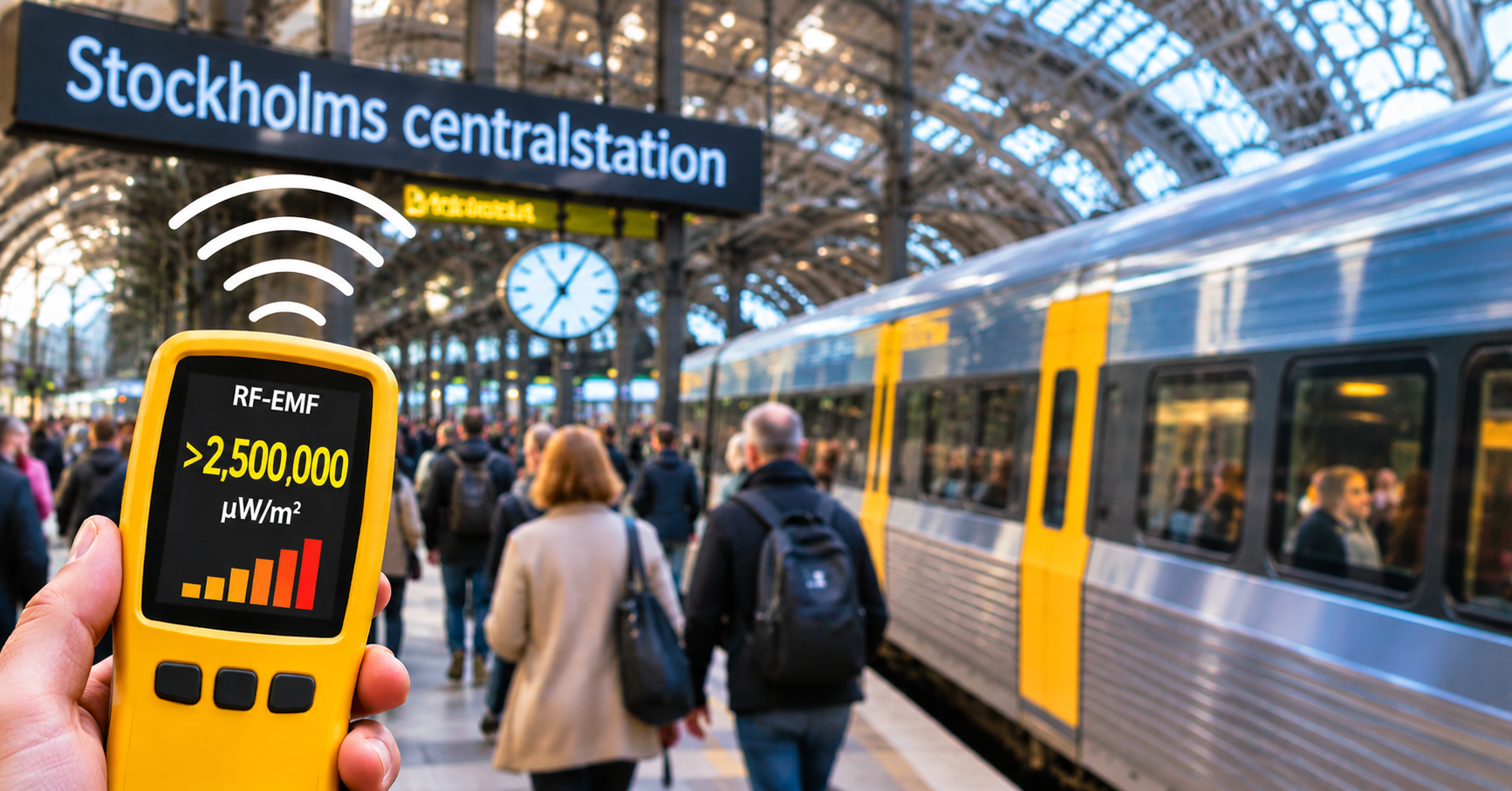
A new Swedish scientific study shows that passengers using public transport may be exposed to very high levels of microwave radiation. The highest levels were measured at Stockholm Central Station, where repeated measurements recorded radiation levels exceeding the instrument’s upper measurement limit.
The study was conducted by researchers Lennart Hardell, the Environment and Cancer Research Foundation and Mona Nilsson, the Swedish Radiation Protection Foundation. The findings were published on October 15, 2026, in the scientific journal Cureus.
Radiation Measurements During Regular Train Journeys
In previous investigations, the two researchers measured radiation levels aboard aircraft, in urban environments, outside schools and in residential buildings.
In this new investigation, they examined how high the levels of microwave radiation, also known as radiofrequency (RF) radiation, can be on trains and in the metro system.
Measurements were conducted in June 2026 at the following locations:
- Stockholm Central Station, both at ground level and on the lower level.
- The Arlanda Express between Stockholm Arlanda Airport and Stockholm Central Station.
- The Stockholm Metro between T-Centralen and Fruängen, in both directions.
- SJ trains between Örebro and Stockholm, in both directions.
Radiation was measured using a Safe and Sound Pro II RF meter, which detects radiation within the frequency range of 400 MHz to 7.2 GHz.
At each measurement location, the highest radiation level recorded during a period of at least two minutes was documented, referred to as the maximum peak value. The results are expressed in microwatts per square metre (µW/m²).
The measurements covered combined radiation from several potential sources, including mobile phone base stations, mobile phones, and wireless networks.
Highest Radiation Levels at Stockholm Central Station
The highest radiation levels were recorded at Stockholm Central Station.
On the western side of the station, facing the railway tracks, radiation levels exceeded the instrument’s upper measurement limit of 2,500,000 µW/m² on all three measurement occasions. This means that the actual maximum levels may have been even higher.
Very high levels were also recorded on the eastern side, facing the main entrance, ranging from 1,300,000 to more than 2,500,000 µW/m².
On the lower level, radiation levels were generally lower, although high maximum values were also recorded there, reaching 1,090,000 µW/m².
The findings demonstrate that radiation levels can vary dramatically between different locations within the same building.
Stockholm Metro
Stockholm Metro, T-Centralen–Fruängen: Maximum radiation levels ranged from 26,300 to 254,000 µW/m².
During the return journey, maximum levels ranged from 15,800 to 419,000 µW/m². The highest level on the return journey was recorded between Slussen and Mariatorget.
Radiation levels therefore varied considerably between different sections of the metro journey, as well as between journeys in opposite directions.
Trains
Train to airport, Arlanda Express: The highest recorded values at the seven measurement locations ranged from 41,900 to 474,000 µW/m². The highest levels were measured at Arlanda Airport and Stockholm Central Station. Approximately half of the passengers in the carriage used mobile phones during the journey.
Train, Örebro–Stockholm: The highest recorded value on the journey towards Stockholm was 1,030,000 µW/m² at Arboga Station. High levels were also recorded at other stations and along certain sections of the railway line.
During the return journey from Stockholm to Örebro, the highest recorded value was 714,000 µW/m².
A recurring finding was that the highest radiation levels were often recorded at railway stations or near major transport hubs rather than during the train journeys themselves.
Median Values
The median values of the recorded maximum radiation levels were as follows:
Arlanda Express: 137,000 µW/m².
Stockholm Metro, T-Centralen–Fruängen: 99,600 µW/m² on the outbound journey and 72,050 µW/m² on the return journey.
SJ train, Örebro–Stockholm: 85,000 µW/m² on the outbound journey and 67,800 µW/m² on the return journey.
The results show that radiation levels varied considerably both between different journeys and between measurement locations during the same journey. The highest levels were often recorded at railway stations and major transport hubs.
These median values represent the median of the recorded maximum levels at each measurement point, rather than the average radiation exposure over the entire journey.
Levels compared with exposure limits
The measured radiation levels were well below the exposure limits recommended by the International Commission on Non-Ionizing Radiation Protection (ICNIRP), which are applied in Sweden as well as in many other countries. The limt is 10,000,000 µW/m², averaged over six minutes or 30 minutes.
ICNIRP’s exposure limits are designed to protect against only those caused by heating of body tissues.
However, these limits have been strongly criticised by many scientists who argue that they fail to provide adequate protection against a wide range of other harmful effects reported in scientific research, including effects associated with long-term exposure, such as cancer negative impacts on the normal function of the brain and nervous system.
These researchers have called for substantially lower exposure limits that would also take into account adverse health effects other than tissue heating.
The radiation levels measured in the present study were, however, considerably higher than the precautionary levels recommended in the EUROPAEM EMF Guideline 2016, developed by European scientists and medical experts.
For Wi-Fi exposure, this guideline recommends a precautionary level of 10 µW/m² during the daytime,.
The measured levels were also considerably higher than exposure levels at which studies of long-term exposure to mobile phone base stations have reported increased risks of adverse health effects.
However, because the measurements in this study represent maximum peak values, they cannot be directly compared with ICNIRP limits, which are based on radiation levels averaged over six minutes.
Consequently, the difference between the measured peak values and the ICNIRP limit is even greater than a simple numerical comparison might suggest. The ICNIRP limits may allow short-duration peak values substantially exceeding 10,000,000 µW/m², provided that the applicable time-averaged exposure limits are not exceeded.
Hardell L, Nilsson M. Swedish Public Railway Transportation Environments May Be Associated With High Exposure to Radiofrequency Electromagnetic Field (RF-EMF) Radiation. Cureus. 2026;18(10).
https://doi.org/10.7759/cureus.117957
